


How I wrote the song “Longest Night of the Year,” which you definitely haven’t heard
Several years ago a friend of mine expressed amazement at my ability to write a song. “How do you do that?” she asked. She didn’t mean me, exactly. She meant, “how does a person write a song?”
I was surprised by the question. Not entirely ironically, I replied, “How do you NOT write a song?”
And thus started an on-again, off-again years-long discussion of whether writing a song was impossible (her position) or whether it was inevitable (my position).
I guess I have decided that it is near the middle. If I had to pin it down, I'd peg it somewhere closer to “unlikely”. Songwriting can be done, but it takes some effort.
Evidence: there are songs.
But they are not inevitable. Evidence: my friend has not written a song. Yet.
So I will walk through the process of how I wrote my song “Longest Night of the Year." A draft of this song was recorded and shared on my Soundcloud account the day before winter solstice in 2020. The final version was released as a single on all streaming sites roughly the same week in 2023.
How it started
Perhaps the Genesis of this particular song came months ago when I heard Jeff Tweedy on Live From Here. One of the songs he played was “Having Been Is No Way To Be”.
The song really spoke to me. The whole notion of “having been” resonated deeply, reliving past glories or believing yourself to be the person you were in the past. I understand the need to reject defining yourself by describing who you used to be.
Four sentences ago I nearly called Tweedy “former Wilco frontman,” but doing so would demonstrate a complete ignorance of the point of his song.
Anyway, if you listened to my song, “Longest Night…,” then listened to (or already knew) “Having Been…” you’ll see part of the secret sauce of songwriting, at least for me. I stole it.
I stole it.
The order and progression of the verse and bridge chords are, as near as I can tell, straight from this song. I may have mixed in a little “No Myth” by Michael Penn, but let’s face it, both of those comparisons are obvious self-flattery. My melody is different, and arrives slightly later, and his rhythm is more complex, but to me the thievery is evident.
So anyway, I had an outline now for how a verse would work, and how a bridge might go, but every song needs a chorus — the part you return to that catches the mind and the ear.
(If you want to better understand a theme in the song “Having Been Is No Way To Be,” you could do worse than by reading the Erika Burkhalter essay “Jeff Tweedy and the Doors of Perception” (below.) Arrive for the brief Jeff Tweedy backstory, stay for a perspective on changing your perception.)
Writing the chorus of my song
As often happens, I had recently been turning a particular phrase around in my mind, and pondering it in my journal.
The winter solstice was approaching and I was fascinated with the idea of the “shortest day” of the year. It was interesting scientifically, in terms of available sunlight, and emotionally, in terms of having less time to accomplish what needed to be done.
What does “the shortest day” mean? It felt inherently and urgently negative; it carried the kind of internal conflict that gnaws on the mind.
And so did its counterpart, the longest night. This is where my mind went, as my journal revealed.
As it happens, I have rather recently introduced some serious conflict to my marriage. That is a story for a different time.
Thus, the concept of a long night weighed on my mind, from recent experience. Hours pass where you lie awake, considering your choices and their implications, and daylight is your signal that it is reasonable to leave your thoughts and start your day.
The solstice meant not just the absence of light, but also the fear that you may have lost the most important relationship in your life. These nights feel endless. Each one could well be the “longest night of the year.”
The chorus had to end with that line. Needed to. But how to get there?
There was “build” in the music of the chorus that implied an internal rhyme. How to convey the pain of the potential loss of a person you have built your life around? It can feel like a mortal wound.
“You’re killing me. You’re filling me … with words I don’t want to hear. / On the longest night of the year.”

Writing the first verse
So, there was only one place to go from this refrain: This was a breakup song.
Not my first.
I called heavily on past breakups, some of which resulted from relationships more imagined than real.
The first signs of a breakup are the changes in scheduling, right? How the other person — who used to make every excuse to be with you — is now making excuses to be away from you. That’s what I was thinking.
A missed (or unmade) phone call, a perilous drive, obligations …
“Storm blew down the wires you weren’t calling me on / Snow covered the roads you won’t drive in the dark / You say you really want to make it, but there’s something you’ve got to do …”
That sort of came in a burst. In one piece.
And a note on that, the third line as I wrote it initially was, “You really want to make it here.” This, on the surface, conveys the same idea.
But, to be blunt, this is rock and roll. There was not enough sex. I could keep the rhythm of the line, but play on the words “make it” to imply more than just a visit to a location on a map.
“You say you really want to make it” was how it made it onto the recording. I imply my own doubt with “You say …” and then add a little spice with “make it.”
I still needed another excuse from the distant lover, progressively more dismissive than the ones before it. And, of course, I wanted it to rhyme. I tied it in to the “not driving” reason, throwing in a dismissive word to launch: “Anyway, there’s no place here to park.”
Writing the second verse
There are several brilliant lines in Tweedy’s “Having Been …” The image that sticks with me seems to describe the effect that deep grief has on one’s sense of time: “Days pass below like train windows.”
When Tweedy sings this, I am on the subway in NYC, trying to see faces in the blur of a speeding train going the opposite direction from mine.
This is how time passes in deep grief. Days and even weeks click by, each framed by nightfall or sleep, progressively accelerating, one indistinguishable from the next.
While a series of particular breakups came to mind, I identified a pattern of breakup behavior I considered universal: someone running home and someone chasing. A negotiation with friends and family just to get access. Insistence. Urgency. Poor decision-making.
I wanted to capture an image that conveyed the broken dreams and irrationality of heartbreak the way Tweedy’s image captured the mood of his song.
“We didn’t make it to China, I didn’t make it to the end of the road / In the snow you couldn’t tell my feet were bare.”
And in this case, it has the added bonus of reflecting an actual breakup in my past. There it was — drawing together winter, irrational behavior, and an image of my hypothermic bare feet in the snow that we all can see and, just as importantly, feel. And now back to the plot.
“It’s a kind of puzzle how to get your mom to admit your home / What do I keep secret, what do I share?”
How do I structure my song?
There is no wrong way to structure your song.
Keep in mind that the structure of a song can — and generally should — support your theme.
Conventionally, a song alternates verse and chorus, with a bridge about three-fourths of the way through. I do this a lot. It’s comfortable.
The bridge typically arrives late to break the song up. It helps maintain engagement by keeping things moving and changing.
But if you want your song to feel longer, without actually being longer, you move your bridge to the middle of the song. It is, after all, the “Longest Night of the Year.”
That is what I did, anyway.
And I made my bridge about the music, and not lyrics. I often use a solo guitar lead to mimic the verse notes, but for this I introduced a different melodic line, to help the bridge feel a bit different.
As for the chord progression in the bridge? Stolen. See earlier note.
To be fair to myself, the kind of music I listen to and write utilizes a large pallet of sounds but a small pallet of common chord progressions. There just aren’t a lot of places to take the bridge musically that feel “right” to many who have listened to American pop music for 40 years.
That’s where I went.
So for “Longest Night” my structure is simple: there are two sets of “verse and chorus”, with a musical bridge as an interlude.
Writing the third verse
Well, now we descend into hopelessness. At least, my protagonist does. And I try to impart some hard-earned wisdom.
“You can’t make something happen, just by wanting it so much / With days and weeks of sweat your sacrifice.”
And of course, in a marriage, things are even more complicated than a typical breakup. So enter the lawyers. But how? They usually come in all backwards, like circus clowns. This line got written and rewritten multiple times.
The change that is the easiest to explain (there are dozens of tweaks to some songs. Hundreds to others) was made to the initial line “just like a lawyer to suggest compromise.”
But this lacked … something. What was missing? A couple of ideas later, it was clearer. I reinforced the theme of the song with more precise language by reintroducing loneliness.
“When everyone walks out of the room holding less than when they came in / It’s a lonely lawyer’s compromise.”
Also, though this article presents them chronologically, I wrote the verses out of order. Well, I wrote them in a different order. You can see in the photo of the “recording” version of my lyrics (below) that I used brackets to indicate an improved order as I was wordsmithing.
Writing the final verse
Many idioms exist because they describe a truth. One of those is, “you don’t know what you’ve got til it’s gone.” In that vein, we are all familiar with the sense of intense hopelessness that occurs at the moment that our loss is most evident.
This is what I was trying to capture in the final verse.
Bargaining. Agony. A sharpened sense of distance. And, of course, a chance to re-introduce the lost intimacy suggested by the words “make it” in the first verse.
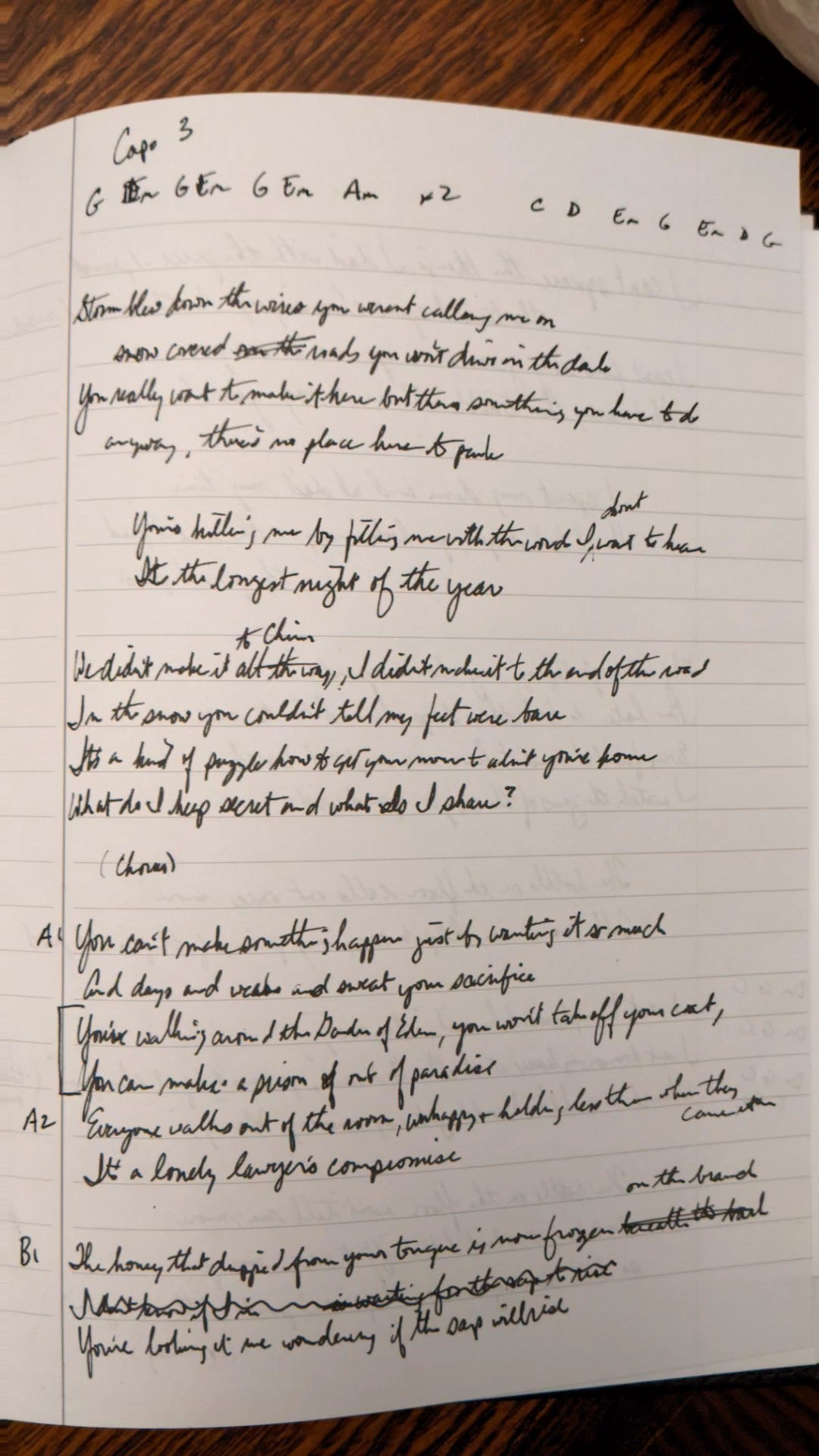
It started with the kind words spoken during the romance phase of the relationship, as “honey dripping off the tongue,” in the common phrase. At first I said the honey was now frozen in the bark.
But, umm, that’s not where honey typically is. Then I said “on the branch” because that is where bees make nests.
Ahh — oh! Science!
It hit me suddenly that beneath the bark was … sap. And this word had a double meaning that fit my purposes deliciously.
It is clear that my protagonist’s predicament, as with most of my breakups in the past, was of his (or her) own doing. Sometimes the error is the cause of the end of the relationship, but sometimes the error is that there never should have been a beginning!
By leveraging the multiple meanings within the word “sap,” I had come across a way to express my partner’s disgust in my actions, and hopefulness about who I could become, while bringing the whole image together. For a “sap” is not just tree food; a sap is a gullible person, a fool.
Me.
I needed a sentence that captures the full scope of the relationship, and an image to convey the long winter … while correcting the “honey” issue.
“The syrup that dripped from your tongue, is now frozen in the bark / and you’re looking at me, wondering if the sap will rise / You’re walking around the Garden of Eden and you won’t take off your clothes / You can make a prison out of paradise.”
I remain especially proud of drawing together two interpretations of “sap rising” into one sentence. The creation of syrup and invigoration of growth that occurs in trees in the spring, coupled with the image of an oaf standing up again after an error or a fall, seemed to create a sense of anticipation or even optimism. This runs against the mood of the rest of the song.
Is this a fulcrum? An anticipated volta? Or merely cognitive dissonance?
It could go either way. I can’t answer every question. For part of the gift of a song is the work of the listener.
How to write your song
In James Thurber’s essay “How to Name Your Dog,” he pauses to lament that, as he feared, he’d veered off and started writing an essay about how not to name your dog.
I worry that I have done something similar. I have offered no advice, as of yet, for how you can write your song.
So here is the TL;DR that is not a summary as much as implied advice, summoned from the article above:
How to write a song
- Think of a song you like, and musically steal parts of it. Or all of it. (It’s really okay. First, there is very little chance that your song will be popular enough, or even sound enough like the other song, to ever draw attention of copyright lawyers. And if they do, now you’re popular and you sound like a famous musician! Pay a percentage of your profits; don’t be cheap.)
- Tell a story that is something like what happened to you, and something like what happens to everyone. (It sounds crazy, but the more personal you make your observations, the more universal they become. Leave out people’s names and particular details, but be honest about the emotions, and it will resonate with others.)
- Whichever part is the catchiest … that is your chorus. Make sure you do that part a few times.
- Rhyme. (I know your English teacher told you this is not a requirement for poetry, and songwriting is poetry, but … well, yes it is a requirement.)
- The structure of your song is: intro, verse, chorus, verse, chorus, bridge, chorus, chorus. (Unless it isn’t. Start there, but change it for some reason or another. Then the new way is the right way. You are now, after all, an artist.)
But you don’t have to take my word for it. I used a company called Landr to create a final master of the songs on my first and second albums. They do a great job supporting amateur songwriters with inexpensive but powerful tools and information. (This is not a paid promotion, nor is the link, I swear!)
I went a different route with my third album, seeking instead an established studio, professional musicians, and a local person with some Grammy experience to master the songs.
Anyway, here is a longer, more comprehensive instruction manual for writing your song:
Who am I to tell you how to write songs?
I’m just this guy. I’ve made a Soundcloud account where I capture sounds from my phone and I upload rough drafts of my songs from Garageband.
In the winter of 2016–17 I recorded an album, mostly on Garageband in my basement but partly in the loft of a studio apartment of an acquaintance of mine. The musicians are me and, on some songs, my son. I published it through CDBaby and it’s now on a streaming service near you.
It is unpolished, and has moments of rank amateurism. It has moments of transcendent beauty. My friend Erin’s daughter’s favorite song is “When Did I Die.”
She was four years old when I wrote this article.
And I’ve wondered aloud about my friend’s choice to make her daughter listen to it in the car.
CDBaby keeps track of streaming music sales, and CDs or electronic downloads of my album from their site. I’ve made $39.16. Or $13 a year.
That’s less than it cost to print the 100 CDs I ordered in a fit of completely unfounded optimism.
Last summer I recorded my third album My wife prohibits me from sharing how much it cost to produce, but she can’t keep me from insisting it was worth every penny. The full album available at the following places:
and of course on this very website.